
Neoliberalism, this false ideology, is devoid of courage, grace, kindness, compassion and empathy, whilst it champions individualism, selfishness, arrogance and greed. It fuels wars, bombs, missiles, death, destruction, environmental degradation and global warming, as well as extreme inequality and abject poverty,..., for the 99%, who bear the inherent costs of immoral capitalism, whilst ushering in a beautiful socialism with all its benefits for the 1%: This is the legacy of the neoliberal economists who have corrupted and distorted the legacy of the real Adam Smith
Adam Smith, the moral philosopher and then, the economist: 'The Father of ‘Three Primary Virtues- Prudence, justice and benevolence.’ They all constitute a sine qua non condition for the achievement of “human excellence” and are dependent on each other.' Without these virtues, the “invisible hand of the market” will become nothing but the visible hand of destruction. Exactly what has happened 250 years later, lest we forget.
Celebrating 250 Years of the Wealth of Nations
Excerpts (in italics) above and photo via Shapero Rare Books
‘The philosopher Adam Smith wasn't the free-market fundamentalist many assume he was. It's time we started reading him properly.’-Amartya Sen in The Economist manifesto
…So, it is my sincere hope that in contrast to the dishonest neoliberal economists who in the 1970s and 80s corrupted the legacy of Adam Smith for the interests of Thatcher and Reagan, this time around, the honest, progressive economists will be able to give the world the gift of the real Adam Smith, a moral philosopher first and foremost, and then an economist, so that all may become free from the chains of immoral, neoliberal capitalists and capitalism! Carpe diem!
‘The 250th anniversary of the publication of An Inquiry into the Nature and Causes of the Wealth of Nations on March 9, 1776, is being utilized as a major academic and public opportunity to re-evaluate Adam Smith's work, separating his nuanced philosophy from the modern "free-market" myths. Events in 2026, particularly in Glasgow and at Panmure House, aim to move beyond the caricature of Smith as a "laissez-faire" fanatic and instead present him as a moral philosopher concerned with societal welfare, the dangers of corporate monopoly, and the necessity of justice.’
Part l–Adam Smith through the lenses of the GCGI
Viewing Adam Smith through the lenses of the Globalisation for the Common Good Initiative (GCGI), founded by Kamran Mofid, involves reclaiming the "real" Adam Smith—a moral philosopher rather than merely the father of free-market capitalism. GCGI posits that Smith’s work has been misinterpreted by modern neoliberal economics, separating the market from the moral framework of human relationships and community that Smith prioritised.
Key insights from the GCGI perspective on Adam Smith include:
- Morality Over Market Fundamentalism: Smith did not intend for market mechanisms to replace societal morality. Instead, he envisioned a capitalist economy embedded within a society held together by non-capitalist, community-oriented morals.
- Reclaiming Moral Sentiments: GCGI emphasises that Smith’s The Theory of Moral Sentiments (1759) is crucial to understanding his later work, The Wealth of Nations (1776). The latter is misread when not tempered by the empathy, justice, and benevolence discussed in the former.
- Advocacy for the Common Good: Smith observed that true happiness is found in tranquility rather than constant consumption. His philosophy supports justice, benevolence (doing good), and prudence (careful management of resources) as pillars of a healthy society.
- The "Invisible Hand" Misinterpreted: GCGI often points out that the "invisible hand" is frequently misused to justify greed. Instead, Smith’s work highlights that ethical individuals, working within a moral community, produce better outcomes for all, rather than the unchecked pursuit of self-interest.
- Critique of Excessive Consumption: Contrary to the focus on perpetual economic growth, GCGI argues that Smith's moral philosophy warns against the destructive nature of excessive consumption and a lack of care for others.
In summary, the GCGI looks at Adam Smith as a proponent of a compassionate, community-focused, and ethically grounded economic system, promoting a "better world" that contrasts sharply with modern corporate capitalism. (Excerpts from an AI generated summary)
A selection of articles from our archive on the -REAL- Adam Smith
The World would be a Better Place if Economists had Read This Book
The Theory of Moral Sentiments as was meant by Adam Smith
Imaging a Better World: Moving forward with the real Adam Smith
Adam Smith and the Pursuit of Happiness
In Search of the Light to Change the World
*See also Amartya Sen, ‘The Economist manifesto’ quoted in some of the articles above.
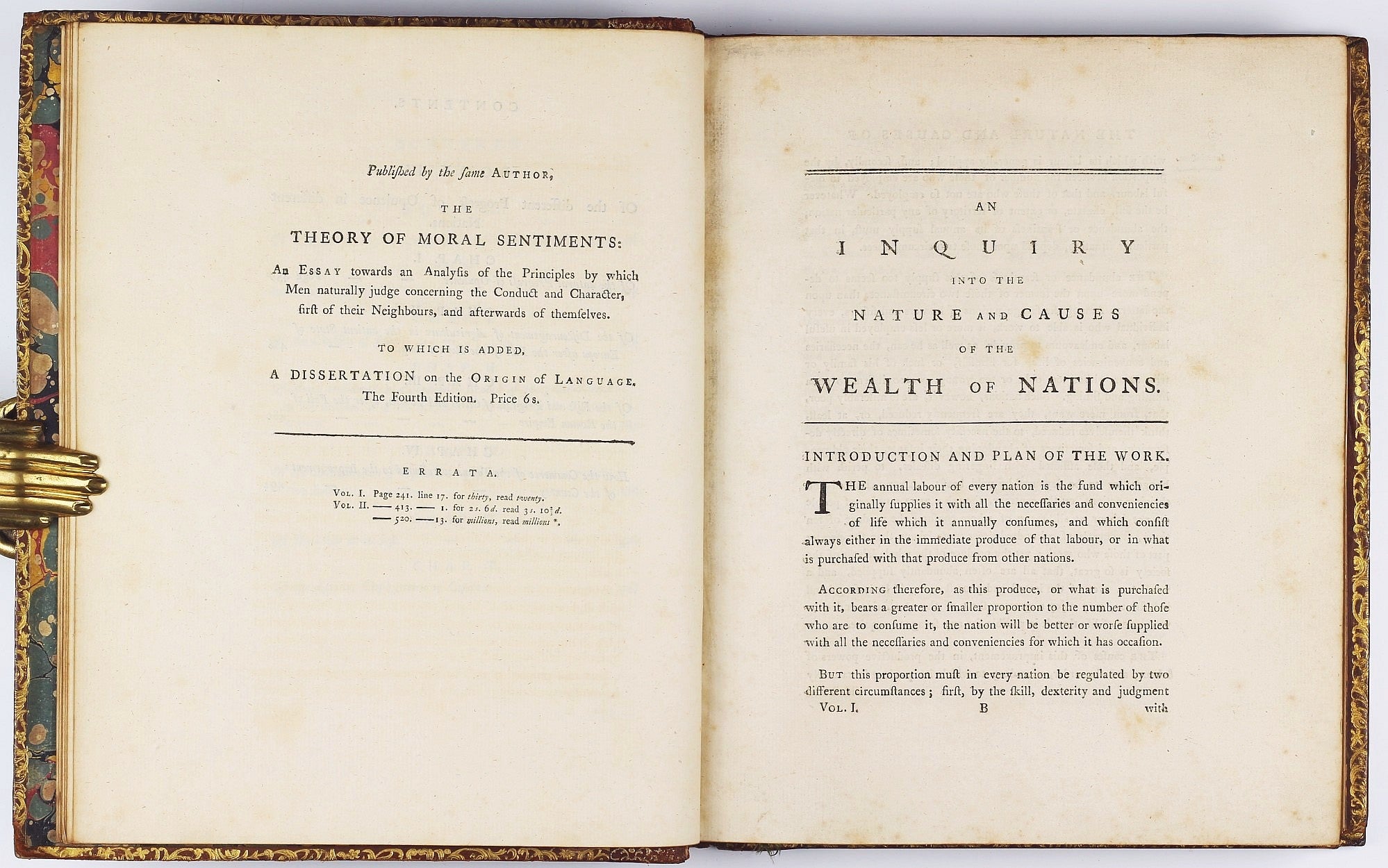
Paratext of Wealth of Nations (1778)
Source: Special Collections Research Center, William & Mary Libraries [Colour figure can be viewed at
wileyonlinelibrary.com]
On the 250th anniversary of The Wealth of Nations, the Scottish philosopher is still invoked by the right. Yet he worried about inequality, monopoly and the power of wealth.’- The Guardian Editorial,11 March 2026
‘This week 250 years ago, Adam Smith published An Inquiry Into the Nature and Causes of the Wealth of Nations – and invented economics. The anniversary has been marked by opinion columns, new books and academic conferences. How different it was 50 years ago. The 1976 bicentenary produced the definitive scholarly edition and helped cast Smith as the father of free-market economics. This was an easy sell during the 1970s slow collapse of the postwar economic order. Smith was useful as a symbolic figure for the revival of free-market ideas. Yet the truth is more complicated.
‘Milton Friedman, a Nobel laureate, recruited Smith as the patron saint of neoliberal economics in his 1980 book and television series Free to Choose – a manifesto that anticipated Reaganism in the US. He reduced Smith to two claims: that a voluntary exchange benefits both parties and that self-interest is led by an “invisible hand” that unintentionally promotes the public interest. In short: greed is good. In fact, Smith used the phrase “invisible hand” only once in The Wealth of Nations, to describe whether merchants invest their capital at home or abroad – and not, as Friedman claimed, as a general theory of markets…’- The Guardian view on Adam Smith: he deserves rescuing from the free-market myth
All said and done, as observed by many, including the FORTUNE, as an example’ The Invisible Hand Has Left the Building:
Over time, the belief that markets would self-correct and growth would eventually “lift all boats,” has lost credibility. We have more knowledge, wealth, and technological competence than any generation in history, yet the world faces multiple existential crises: widening inequality, erosion of democracy, ecological collapse, and a pervasive breakdown of trust in institutions. These are not isolated failures but the inevitable outcomes of a governance model that has prioritized profit above people and the planet, for too long. Capitalism, in its current form, has surrendered its moral authority. Barring a few exceptions, democracy has been downgraded to function as the government of the few, by the few, and for the few…’
So, it is my sincere hope that in contrast to the dishonest neoliberal economists who in the 1970s and 80s corrupted the legacy of Adam Smith for the interests of Thatcher and Reagan, this time around, the honest, progressive economists will be able to give the world the gift of the real Adam Smith, a moral philosopher first and foremost, and then an economist, so that all may become free from the chains of immoral, neoliberal capitalists and capitalism! Carpe diem!